Weeks before his death in January 1883, Gustave Doré completed a set of illustrations for Edgar Allan Poe’s “The Raven.” They were prepared for publication as a Christmas book gift available by October of that year. A copy of the book cost $10 at the time, which is equivalent to $244 today. It sold well and received critical praise. Following are some select images from the edition from the Graphic Arts Collection of the Fireside Library at Princeton University (see full post at https://graphicarts.princeton.edu/2018/03/29/gustave-dores-raven/).


Nancy Allen claims she never realized her character in Carrie was going to be so evil until she saw the finished film. She thought she and John Travolta were playing such self-centered, bickering morons that they were there for comic relief.

Piper Laurie also thought the character of Margaret White was so over the top that the film had to be a comedy.

Read more fun facts at IMDB Trivia: Carrie (1976).
Author F. Scott Fitzgerald, a member of the MGM writing department at the time Freaks was in production, did not quite feel at home with all the movie stars and powerful moguls, so he often dined with the sideshow attractions during his lunch hour.

Fact from Horror Movie Freaks by Don Sumner, Krause Publications, 2010.
Browning, Tod. Freaks, MGM, 1932.

Combining my love for drag queens and horror stories, I wrote a short story about a drag queen who is haunted by the mistakes of her past, in particular, getting a botched nose job and later mocking the plastic surgeon who did it to her on social media. Central to the story is the family bond within the drag community that sparks revenge when torn apart. If you like tales of murder and glamorous men in makeup, I encourage you to give the story a try! You can get your copy at BackupBrain: That Bloody Dress.

The best-known ghost story from ancient Egypt is known, simply, as A Ghost Story but sometimes referenced as Khonsemhab and the Ghost. The story dates from the late New Kingdom of Egypt (c. 1570 – c.1069 BCE) and specifically the Ramesside Period (1186-1077 BCE).
An excerpt from W.K. Simpson’s The Literature of Ancient Egypt: An Anthology of Stories, Instructions, Stelae, Autobiographies, and Poetry:
Then the High Priest of Amun Khonsemhab said to him: “Please tell me your name, your father’s name, and your mother’s name that I may offer to them and do for them all that has to be done for those in their position.” The august spirit then said to him: “Nebusemekh is my name, Ankhmen is my father’s name, and Tamshas is my mother’s name.”
Then the High Priest of Amun-Re, King of the Gods, Khonsemhab said to him; “Tell me what you want that I may have it done for you. And I shall have a sepulcher prepared anew for you and have a coffin of gold and zizyphus-wood made for you, and you shall [rest therein] and I shall have done for you all that is done for one who is in your position.”
The august spirit then said to him: “No one can be overheated who is exposed to wintry wind, hungry without food… It is not my desire to overflow like the inundation, not…not seeing my tomb… I would not reach it. There have been made to me promises…”
Now after [he] had finished speaking, the High Priest of Amun-Re, King of the Gods, Khonsemhab, sat down and wept beside him with a face full of tears. And he addressed the spirit, saying, “How badly you fare without eating or drinking, without growing old or becoming young. Without seeing sunlight or inhaling northerly breezes. Darkness is in your sight every day. You do not get up early to leave.”
Learn more about the origins of this ghost story and read the story’s full transcript at A Ghost Story of Ancient Egypt.
Baba Yaga is one of the most famous characters in Slavic mythology. The old crooked-nosed hag is as evil as she looks. She is both a force of nature and a cruel old woman who eats people who dwell into the deep forest. Her name comes from the Slavic word for grandmother “Baba.” The meaning of the word “Yaga” is not certain but some think it means “wicked.”
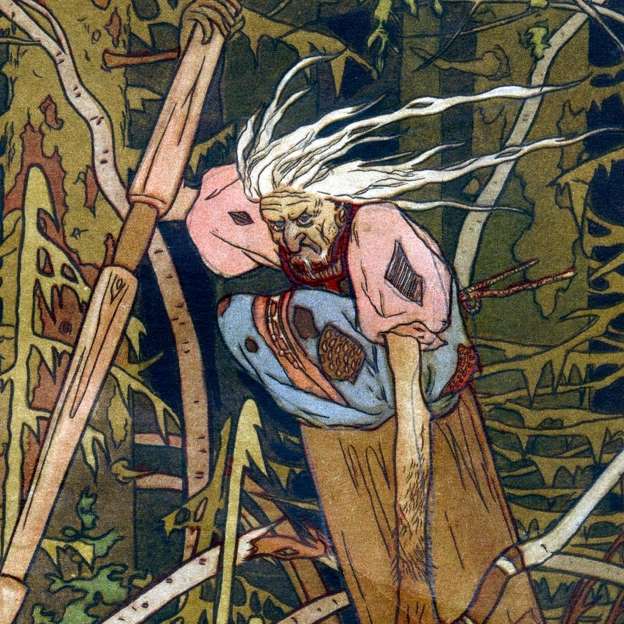
In some myths, Baba Yaga gives tasks to her victims and, depending on the successful completion of their mission, they are either eaten or rewarded. She is not only an evil villain but, in many cases, she could even help them, like in the Russian story of “Vasilisa the Beautiful,” where Baba Yaga gives Vasilisa tasks to accomplish in trade for help.
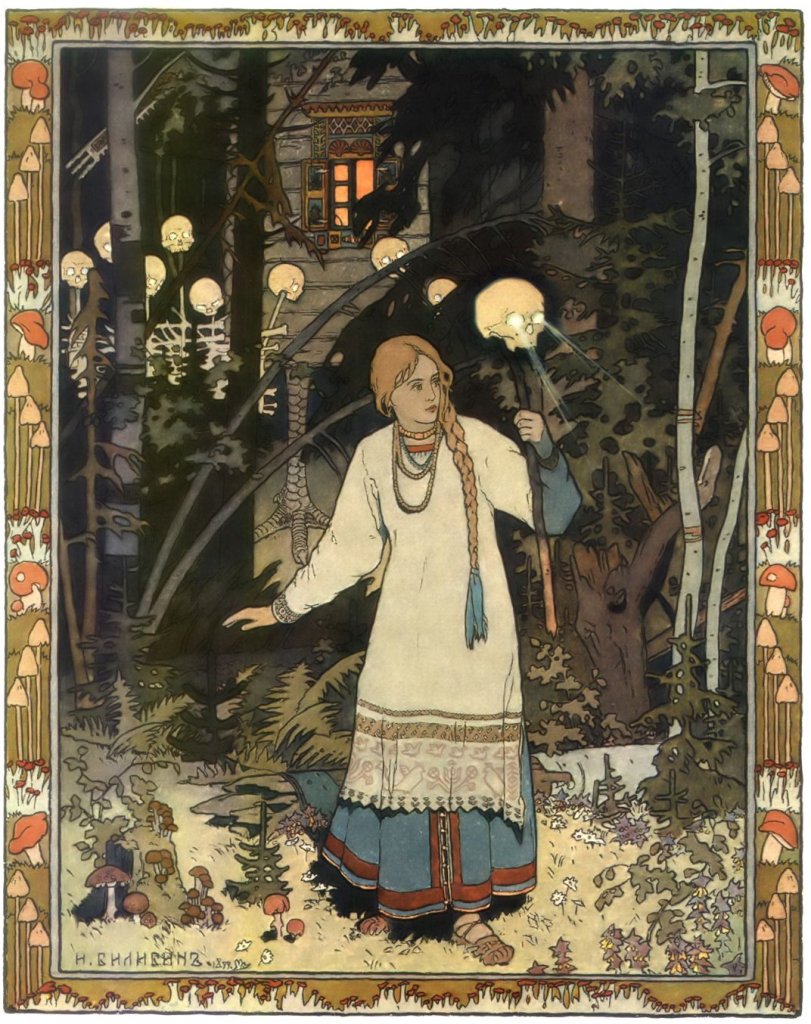
Read more about Baba Yaga at Baba Yaga – The Mythical Forest Witch from Slavic Folk Tales.
A library in Dublin, Ireland, recommends the following three books about women who “are different, the outsider who does not conform, the outcast who does not comply, and are therefore a danger.” Visit Witchy women on BorrowBox for descriptions of each title.