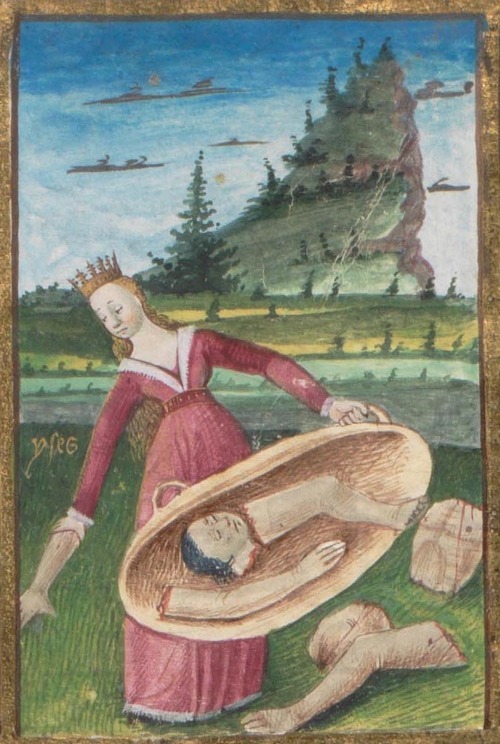
Boccaccio, Des cas des nobles hommes et femmes
15th Century
She Blogged By Night has a great post about the history of the Mike Myers mask from Halloween, A Very Brief History of a Very Famous Mask. I like these pics, in particular. Happy Halloween!


“Houdini had made a career out of surviving the impossible, which only made the circumstances of his 1926 death all the more mysterious. The 52-year-old performed before a packed house in Detroit on October 24, but was rushed to the hospital afterwards with an apparent case of appendicitis. He died just a week later on Halloween, leaving his legions of admirers bewildered. An obituary in the New York Times expressed shock at the sudden passing of the man ‘who so often had seemed to thousands to be cheating the very jaws of death.’
“The strange series of events that led to Houdini’s demise had kicked off several weeks earlier on October 11, 1926. While being shackled into his Chinese Water Torture Cell during a performance in Albany, New York, the conjurer was struck on the leg by a piece of faulty equipment. He hobbled his way through the rest of the show, but was later found to have sustained a fractured left ankle.

“Against doctors’ orders, Houdini continued his tour and traveled to Montreal, where he gave a lecture at McGill University. Just a few days later on October 22, he invited some McGill students to visit him in his dressing room at the Princess Theater. The magician’s sore ankle was still bothering him, so he plopped down on a couch while the group chatted. At some point, a student named J. Gordon Whitehead arrived and asked Houdini if it was true that he could resist hard punches to his abdomen—a claim the magician had supposedly made in public. According to witness Sam Smilovitz, when Houdini said the rumors were true, Whitehead abruptly delivered ‘four or five terribly forcible, deliberate, well-directed blows’ to his stomach. Houdini was still reclined on the couch and had no time to prepare for the punches, which appeared to leave him in considerable pain.

“Houdini brushed off the incident at the time, but that same evening, he began to complain of discomfort and stomach cramps. His condition only worsened the next day, when he boarded an overnight train to Detroit for a new run of performances. The magician developed severe abdominal pain, cold sweats and fatigue, and his temperature rose to 104 degrees. A doctor suspected appendicitis and instructed Houdini to go to a hospital, but the performer insisted on taking the stage for his opening night show at the Garrick Theater. He proceeded to struggle through his routine before collapsing immediately after the final curtain.
“The show would be Houdini’s last. That same night, he was taken to a Detroit hospital and prepped for surgery. Doctors successfully removed his appendix, which was found to have ruptured several days earlier, but it had already poisoned his insides. Despite a grim prognosis, the magician clung to life until October 31, when he died with his wife Bess and his two brothers by his side.”

Continue reading about the mysterious circumstances surrounding Houdini’s death at History.com’s What Killed Harry Houdini?
“With Poltergeist‘s success came a creepy mystique that the classic film is shrouded in real-life tragedies that some interpret as a curse.
“The majority of the fuel for the alleged curse stems from the deaths of multiple cast members. In total, four cast members died during and soon after the filming of the series. Two of these tragic deaths were highly unexpected and puzzling, leading many fans to speculate on the trilogy’s eerie implications.
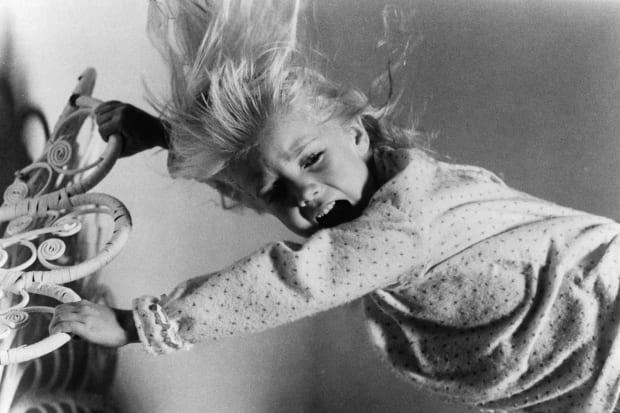
“Carol Anne Freeling, the young focal point of the series, was played by Heather O’Rourke. Only six years old when the first Poltergeist film was released, O’Rourke captivated audiences with her stark blond hair, doll-like appearance, and big, inquisitive eyes. Sadly, however, she was misdiagnosed with Crohn’s Disease in 1987. The following year, O’Rourke fell ill again, and her symptoms were casually attributed to the flu. A day later, she collapsed and suffered a cardiac arrest. After being airlifted to a children’s hospital in San Diego, O’Rourke died during an operation to correct a bowel obstruction, and it was later believed that she had been suffering from a congenital intestinal abnormality. She will be, and has been, missed by fans around the world.
“Dominique Dunne, who played the original older sister Dana Freeling, met an equally tragic and unforeseen fate. In 1982 Dunne separated from her partner, John Sweeney. In November of that year, he showed up at Dunne’s house, pleading for her to take him back. When she refused, Sweeney grabbed Dunne’s neck, choked her until she was unconscious, and left her to die in her Hollywood home’s driveway. Sweeney was sentenced to six and a half years in prison but was released after three years and seven months.
“The other two cast member deaths, while unfortunate, were not as unpredictable or mysterious. The evil preacher Kane from Poltergeist II was played by Julian Beck. In 1983, Beck had been diagnosed with stomach cancer, which took his life soon after he finished work on the second installment of the series. The same film was met with further tragedy, after Will Sampson, who played Taylor the Native American shaman, died after undergoing a heart-lung transplant, which had a very slim survival rate.”

My Mom loved Royal Doulton figurines when I was growing up, so they have a special appeal to me. You can imagine my delight when I first came upon the work of Jessica Harrison from the United Kingdom. She takes Royal Doulton figurines and revises them into gruesome ladies. Some are holding an internal organ or their entrails in their hands pulled out from their bodies. Others have chopped off limbs or are decapitated or nearly decapitated.

Visit Harrison’s online shop to see more of her work. She is selling prints of images of these pieces, so you can add one to your home.
“During the 17th century, plague doctors started wearing uniforms in an effort to protect themselves from their patients. Charles de l’Orme came up with concept of the long, dark robe worn with boots, gloves, and a hat in 1619.
“The idea was to keep the physician’s entire body covered. The outer layer of the costume was made of goat leather and often coated in wax. Underneath, the doctor wore a blouse that tied to his boots.
“The infamous plague masks were actually associated with air purity. During the 17th and 18th centuries, the idea that the air could be polluted became widespread and doctors sought to prevent ‘bad air,’ or the miasma, from getting to them.

“Eye holes were fitted with glass pieces so doctors could still see, and the long noses on the mask were filled with drugs and aromatic herbs, including mint, camphor, cloves, straw, laudanum, rose petals, and myrrh to filter the air. The herbs also helped with the smell, considering that the dead bodies and lanced buboes that doctors dealt with were rather pungent.”

Learn more about plague doctors at Horrifying Things Most People Don’t Know About Plague Doctors.

 The Devil's Muse