
Category: art
-
A Medieval Good Death
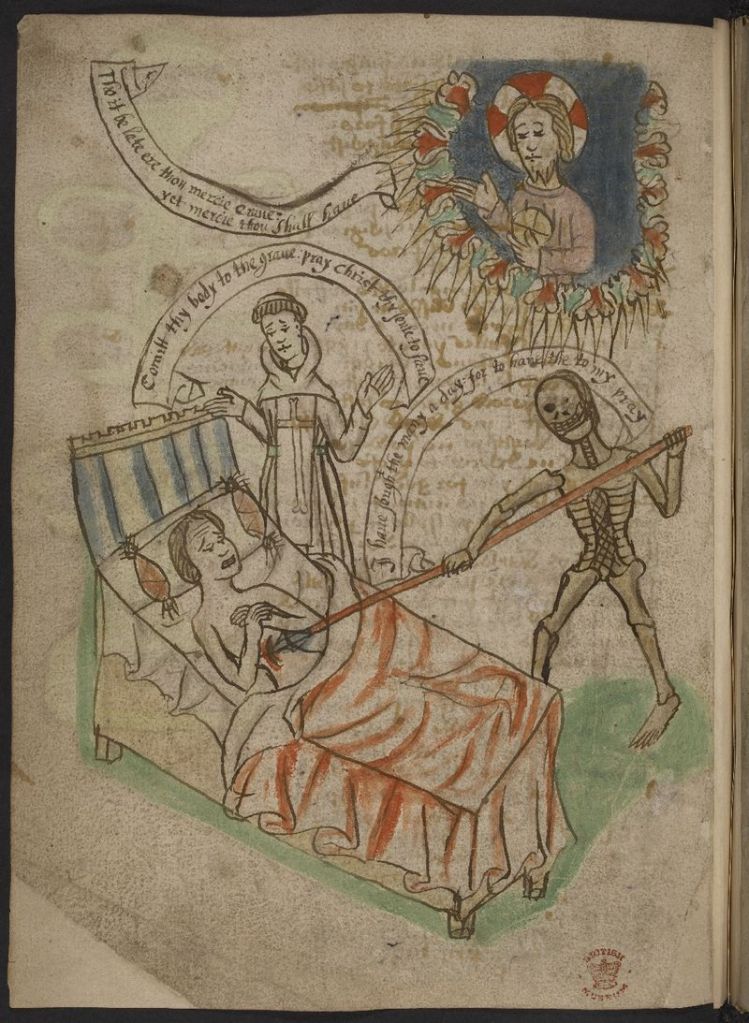
An illustration of a medieval “good death.” A man in bed is struck by the figure of Death, while a monk at his side urges him to “pray Christ thy soule to save,” and Christ promises “mercie thou shall have.” The Carthusian Miscellany, England (Yorkshire or Lincolnshire), 1460-1500
From Medieval Manuscripts Blog – Byland Abbey Ghost Stories: A Guide to Medieval Ghosts
-
The Dance of Death
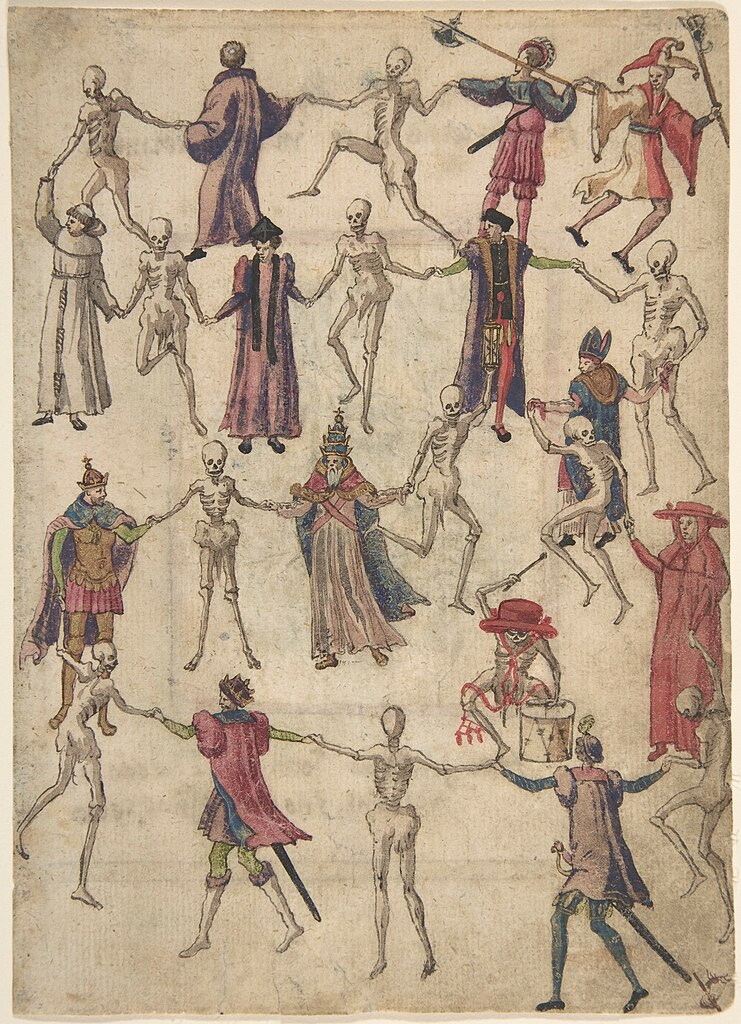
16th Century, from wikimedia commons
-
Rebel

by Gustave Doré, 1866
(https://commons.wikimedia.org/wiki/File:Paradise_Lost_37.jpg)“Satan, now in prospect of Eden, and nigh the place where he must now attempt the bold enterprise which he undertook alone against God and Man, falls into many doubts with himself, and many passions, fear, envy, and despair; but at length confirms himself in evil, journeys on to Paradise whose outward prospect and situation is described; overleaps the bounds; sits in the shape of a cormorant on the tree of life, as highest in the garden, to look about him. The garden described; Satan’s first sight of Adam and Eve; his wonder at their excellent form and happy state, but with resolution to work their fall; overhears their discourse, thence gathers that the tree of knowledge was forbidden them to eat of, under penalty of death; and thereon intends to found his temptation by seducing them to transgress: then leaves them a while to know further of their state by some other means.” – Book IV, Paradise Lost, John Milton, 1674, based on text from 1817 London edition
-
The Death of Cleopatra

The Death of Cleopatra, by Reginald Arthur, 1892 Give me my robe. Put on my crown. I have
Immortal longings in me. Now no more
The juice of Egypt’s grape shall moist this lip.– Cleopatra,
Antony and Cleopatra, Act V, sc ii, 335-337,
Shakespeare -
And She Was a Witch

And She Was a Witch, 1877-84, by George Fuller
The Metropolitan Museum of Art -
The Camden Town Murder, or What Shall We Do for the Rent?

The Camden Town Murder or What Shall We Do for the Rent? by Walter Richard Sickert, ca 1908 From the Yale Center for British Art:
This is one of several paintings Walter Sickert made in response to a gruesome murder of a prostitute that took place in Camden, North London, in September 1907. Sickert, who had worked in the area for several years, was intrigued by the unsolved case, using the title The Camden Town Murder for a group of paintings between 1908 and 1909. None of these works depict an actual murder, with the woman in this painting popularly supposed to be sleeping rather than dead. Sickert’s use of the alternative title in parentheses—a wry parody of Victorian narrative paintings—confirms the artist’s refusal to confirm a single meaning for this enigmatic picture. What is never in doubt, however, is Sickert’s commitment to subject matter that many of his contemporaries would have seen as sordid, rendered in a markedly modern style.
Gallery label for installation of YCBA collection, 2016
For a full discussion on the painting and the series, visit Walter Sickert: The Camden Town Murder and Tabloid Crime by Lisa Tickner published by the Tate.
-
Madame Tussaud & Her Waxworks
Tour of Madame Tussauds London – 1998
Tour of Madame Tussauds London Chamber of Horrors – 2022


